
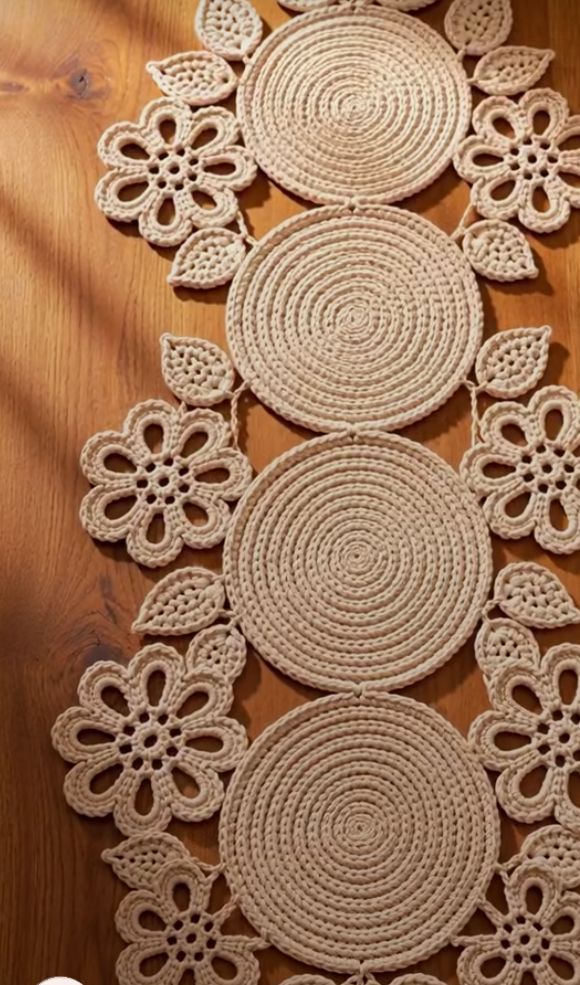
A practical reconstruction guide inspired by the reference photograph
Design Overview
This elegant monochrome table runner combines large, tightly crocheted circular medallions with open-petal flowers and small pointed leaves. The circles form the central spine, while flowers and leaves create a light botanical border along both sides. Because the photograph does not reveal every stitch, the instructions reproduce the visible construction and proportions rather than claiming to be the original pattern.
Suggested Finished Size
For a four-circle runner like the visible section, aim for approximately 30–35 cm (12–14 in) wide and 95–115 cm (37–45 in) long. The modular construction makes it easy to shorten or extend.
Materials
Cotton or cotton-blend yarn in cream/ecru (DK or light-worsted suggested); 3.0–3.5 mm crochet hook; yarn needle; scissors; stitch markers; measuring tape; rust-proof pins; blocking surface.
Abbreviations (US Terms)
ch = chain; sl st = slip stitch; sc = single crochet; hdc = half double crochet; dc = double crochet; tr = treble crochet; st/sts = stitch/stitches; sp = space; inc = increase; rep = repeat.
Construction Plan
Work separate motifs, block them individually, then join them. A balanced four-circle version can use 4 large circular medallions, 6–8 six-petal flowers, and roughly 12–20 leaves. Arrange the circles in a straight line and alternate flowers along both sides, filling gaps with leaves.
1. Large Circular Medallion
Make a magic ring. Rnd 1: 6 sc. Rnd 2: 2 sc in each st (12). Rnd 3: *1 sc, 2 sc in next st* (18). Rnd 4: *2 sc, 2 sc in next st* (24). Continue increasing by 6 sts per round, adding one more plain sc between increases each round. Work continuously for the spiral-like appearance. Continue until about 18–22 cm (7–8.5 in) across. Finish with an even sc round. If the circle cups, increase a little more often; if it ripples, reduce increases.
2. Open Six-Petal Flower
Ch 6 and join into a ring. Work 12 sc into ring. Make six center arches: *ch 3, skip 1 st, sl st in next st*. Into each arch work (sc, ch 8, sc). Around each ch-8 loop work sc, hdc, 7–9 dc, hdc, sc. Adjust the dc count so each petal lies flat. Optionally add a final sc outline.
3. Pointed Leaf
Ch 9–11. From the second ch work sc, hdc, dc, dc, tr, dc, hdc, sc. Work 2–3 sts in the final chain to turn the tip, then mirror the sequence down the opposite side. Add an optional sc edging and small picot at the point. Leave a long sewing tail.
4. Arrangement and Joining
Block motifs first. Lay the circles in a straight column with edges touching or nearly touching. Join neighboring circles discreetly at one or two points. Place flowers near side junctions between circles and additional flowers beside circle edges. Arrange leaves in pairs around flowers, pointing outward. Use short 3–6 chain bridges where motifs do not naturally touch.
5. Finishing and Blocking
Weave in ends securely. Damp-block according to the yarn care instructions. Pin circles round, open the petals evenly, and shape leaves to neat points. Let dry completely before unpinning. Blocking is important for keeping the runner straight and crisp.
Customization Ideas
Keep it monochrome for a vintage look, or use sage leaves with ivory circles, dusty-pink flowers, or pure white mercerized cotton. To lengthen the runner, add more circles and repeat the flower-and-leaf arrangement.
Important Pattern Note
This guide is derived only from the supplied photograph. Exact stitch counts, yarn weight, hook size, original dimensions, and joining method cannot be confirmed from the image. Make a sample motif first and adjust as needed so every component lies flat.